As part of the development of infrastructure for Space Weather research, Türkiye’s first and largest Neutron Monitor was manufactured at the Istanbul University Observatory Application and Research Center. Through collaboration between Istanbul University and the Türkiye National Observatories, it has been installed at the Eastern Anatolia Observatory Campus on Karakaya Hill in Erzurum (at an altitude of 3,170 m) under the Türkiye National Observatories and has commenced its observations.
The system consists of 3 LND 2061 neutron monitor tubes, each approximately 2 m in length and 15 cm in diameter. These tubes contain Boron Trifluoride gas at a pressure of 200 Torr at 21°C. Subjected to an electrical voltage of approximately 1700 Volts, this gas converts neutrons hitting the medium into electrical pulses. The generated signals are converted into TTL signals via PDT 20A HN connectors and transferred to a BeagleBone computer board through custom-designed circuits; thus, ambient neutron levels are digitally collected in real time and can be monitored securely. To block noise and other low-energy particles, as well as to convert neutrons into other detectable particles, the entire system is shielded with approximately 3 tons of lead and polyethylene materials.
Integrated into the specially designed container housing the Mirya-1 muon monitor system—which has been collecting data at the same location since 2024—this new neutron monitor will significantly enhance the precision and scope of space weather research. The simultaneous operation of these two systems featuring different detector technologies will enable the monitoring of high-energy solar particle fluxes, Forbush decreases, and geomagnetic storms with a much more robust and cross-verifiable dataset. Consequently, cosmic ray variations affecting Earth's magnetic field and atmosphere can be analyzed in far greater detail, leading to more accurate results in tracking potential solar storms and space weather events.
This system and infrastructure directly align with the "Space Weather" vision, which is one of the 10 strategic goals of the National Space Program executed under the coordination of the Turkish Space Agency (TUA). It also constitutes one of the core systems of the research infrastructure being established for space weather research within the Türkiye National Observatories. Under the program, the objective is to strengthen domestic scientific infrastructure to monitor the adverse effects of space weather on the ionosphere, satellite communications, and critical ground-based infrastructure, as well as to manage associated risks. The simultaneous operation of this neutron monitor and the Mirya-1 system enhances Türkiye's capability to continuously observe the space environment, making a national contribution to the safety of our country's orbital presence, strategic data accumulation, and global space science.
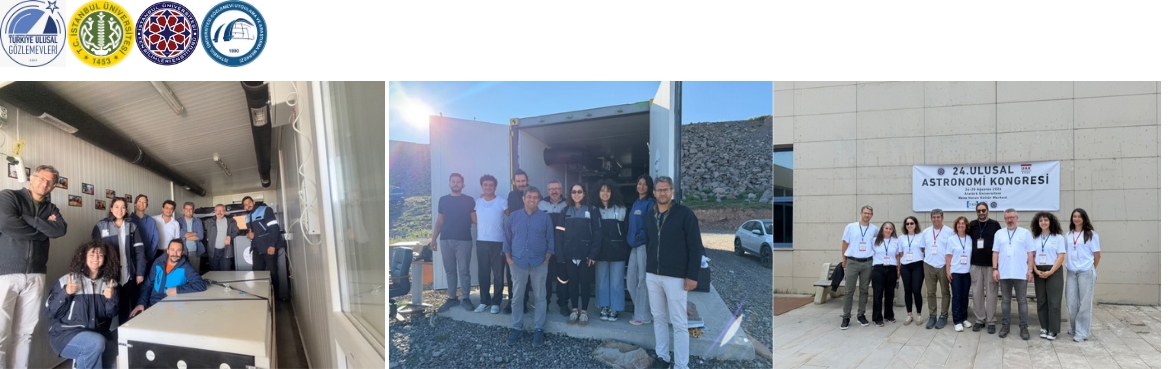
During the production and development process of the system, faculty members from Istanbul University Faculty of Science, Department of Astronomy and Space Sciences Prof. Dr. Tolga Güver and Prof. Dr. Z. Funda Bostancı; Department of Physics faculty member Prof. Dr. Suat Özkorucuklu; Prof. Dr. Cahit Yeşilyaprak, Dr. Hasan Avdan, and Tech. Spec. İsmail Hakkı Gökgöz from the Türkiye National Observatories; Istanbul University Institute of Graduate Studies in Science students Emre Yılman, Tuğba Boztepe, Elif Ece Devecioğlu, and Beste Begiçarslan; as well as Faculty of Science Department of Physics undergraduate student Talia Atalay actively took part. Following the installation, the team attended the 24th National Astronomy Congress hosted by Atatürk University in Erzurum and presented their initial findings.
Current test data has begun to be shared at ist60
This study is supported by the Presidency of the Republic of Türkiye Strategy and Budget Office (under project code 2016K121370). We would like to express our gratitude to the entire team at the Türkiye National Observatories for their unsparing assistance and support throughout the project.
Photo Gallery


